My work at Best Buy
I researched and designed strategies across the Employee Experience to improve workflows; from in-store sales, to warehouse management, to in-home Geek Squad repairs, and everything in between.
Case Study: Best Buy
The Future of the
Employee Experience
Overview
90,000 store employees were operating across a fragmented ecosystem with over 15 distinct digital tools alongside manual/paper processes.
The Challenge
Headquarters had aggressive plans to remove all paper systems with an entirely digital operation, but early pilots suffered from poor adoption and general resistance.
My Role
Leading end-to-end frontline discovery, cross-functional alignment, and enterprise communication strategy.
The Impact
Shifted corporate strategy from “headquarter assumptions” to employee-centered design, saving months of engineering waste on flawed tooling rollouts.
Re-directed a paper-to-digital transformation that would have degraded in-store customer sales experiences into a hybrid approach to meet both HQ and In-Store Associate needs.
Designed a high-engagement notification strategy for The Employee App, which became the foundational playbook for our enterprise-wide communication strategy.
Methodology Highlights
Ethnographic & contextual inquiry
Surveys
Card sorting
The Real Days of a Working Wage
I needed to find out why adoption of digital toolings was so low.
Headquarters had big ideas about the future of work for Best Buy store employees: removing paper tools, consolidating workflows, and driving top-down efficiencies. However, early pilots hit a wall on adoption.
The Approach
To uncover why staff were bypassing million dollar tools, I deployed a layered, immersive field research methodology across diverse markets in the USA (Minnesota, Texas, California, Idaho) spanning both top- and low-performing stores.
Ethnographic Observation: Uncovered environmental friction, real-world constraints, and social-emotional contexts.
Contextual Inquiry: Using master-apprentice modeling I mapped explicit, nuanced workflows directly in the real day-to-day flow of work.
Co-Creative Activities: Conducted journey/mind mapping, “Five Whys", and projective exercises to design ideal future states.



The problem with observation
From Corporate Adversary to Frontline Advocate: Counteracting the “suits are coming to town” effect

Walking into a retail store as “the guy from corporate” instantly triggers defensiveness. Employees naturally assume you’re evaluating their performance and everyone defaults to reciting official training manuals and standard operating procedures.
To break through this barrier and get to the genuine operational truths, I designed my research as a trust-building playbook to turn myself from corporate adversary, to frontline advocate:
Deep Integration: I spent the first days observing, becoming non-threatening, and embedding myself into the teams; working alongside them during shifts, helping out with manual labor, and sharing personal moments together.
Transparent Debriefs: After shifts, at clock-out, or during morning meetings, I held open debriefs with staff and managers. I shared anonymized notes that focused on why a tool failed them (rather than who wasn’t using it).
Co-Creating Insights: Instead of just using my own observer-notes as findings, I asked them to help me create summaries, edit my notes to ensure “the full story”, and ended up with the findings in their own words, not just my own.
The break room confessionals
After a few days of building rapport, the truth revealed itself: improvised workarounds, tired associates, and their genuine day-to-day dynamics.
By mid-week, associates and managers were proactively pulling me aside:
“Hey Ed, can I show you this?”
“Can I tell you something during lunch?”
“Does HQ know we have to do it like this because of…?”
The doomed-to-fail rigidity of digital systems
Corporate HQ had three main assumptions about why the digital tools weren’t being adopted: lack of awareness, confusion / poor UX, resistance to learning new systems.
But my research uncovered a structural flaw that no amount of change management could fix: the digital tools forced rigid standardization into workflows that fundamentally required human flexibility.
Additionally, the 1:1 digitization of paper tools was being pushed onto systems that weren’t even being used as intended in the first place.
The Case of Customer Worksheets
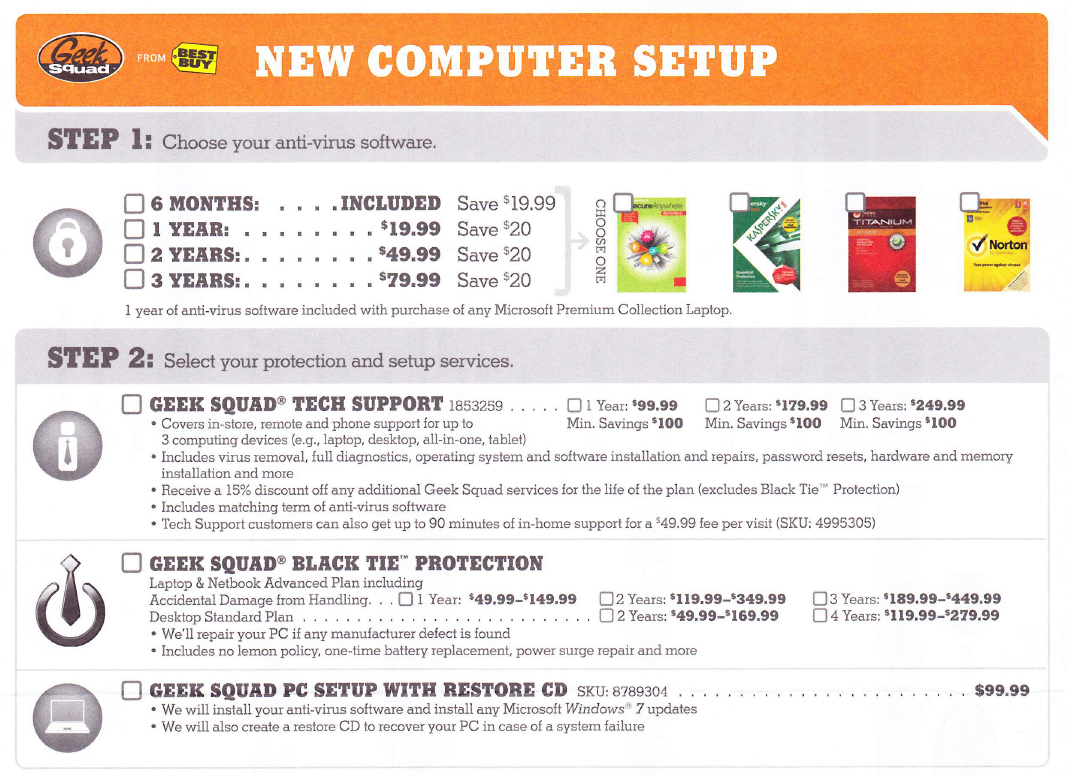
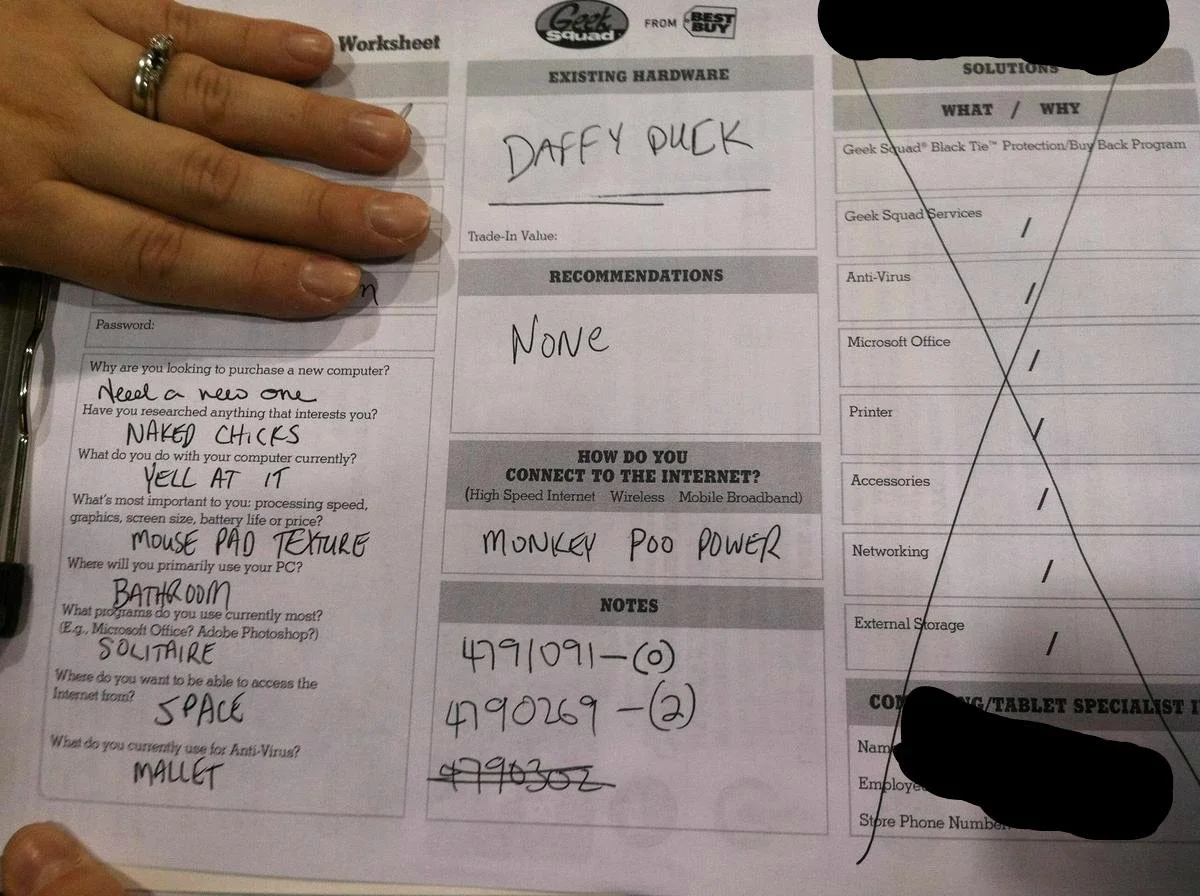
One of the most-critical paper-tools being targeted were the consultation worksheets (used for selling things like mobile plans, laptops, appliances, Geek Squad services, etc.). In theory, it was a standardized checklist of specs and questions to cover with customers.
But in practice, the best Sales Associates didn’t use them. Through my research I identified key reasons why digitizing the worksheets would actively harm the employee and customer experience.
The Screen as a Human-Connection Barrier:
Creates a physical wall. It’s literally putting something between the Associate and the customer, making them appear closed off or unapproachable.
Breaks eye contact and kills natural body language. Associates appeared distracted, breaking the critical human connection that sales required. And, with their hands anchored to a tablet or phone, they lost the ability to gesture or communicate non-verbally.
Shifts the focus to data over people. The Sales Associates knew that the number 1 priority was forming a human connection; the digital tooling disrupted that.
It begs the customer to ask, “Why don’t I just do this myself on my phone?”, which completely undermines the reason they came to the physical store in the first place.

A “Concierge” Consultation with a Collaborative Visual Aid:
When the worksheets were used, they used them collaboratively with customers. They didn’t read from them; they placed them on the counter, circled options, crossed things out, wrote custom notes for the customer to take home. It felt like a white-glove consultation service. The digital systems couldn’t replicate that shared, tactile experience as the information got hidden or was too rigid in the tablet.

The Loss of Local Contexts (why some stores made their own custom versions):
A centralized app cannot account for regional nuances. But the corporate-designed worksheets erased the local expertise given by local Associates. Such as:
In Idaho, farmhouse-style homes often had unique doorframe sizes that couldn’t even fit some modern appliances.
In Minnesota, customers looking for a TV may need to be warned that Monday Night Football was only available on ABC, which was only supported by certain Smart TV models.
The “Take-Home” Resource:
One of the key uses of the paper worksheet was as a resource for customers to take with them. But the digital versions undermined this in a few ways.
It turned a casual, friendly conversation into what felt like a formal customer capture as it required getting their email.
Was a less effective reminder of the conversation. A paper note sits in their bag/wallet/car/countertop, which was a better reminder that they should go to Best Buy for their purchase, instead of getting lost in flooded email inboxes.
All of these reflected a key customer need that Associates were highly attuned to: Why did the customer come to the physical store in the first place? Does a customer coming to the physical store want to look at a tablet screen? Make an account?
The store associates weren’t avoiding these digital tools because they didn’t understand them, or because they just didn’t want to (like HQ assumed). They were avoiding them in order to do better work, to provide their full expertise, to make more sales, to give a better customer experience, and (ultimately) defend our market position.
The Outcome
Pivoting leadership to a hybrid strategy
While I had seen firsthand why the tools were failing, I had to convince leadership that their multi-million-dollar, multi-year strategy was fundamentally flawed, without causing defensiveness.
By presenting these in-depth stories I effectively convinced leadership that this lack of adoption wasn’t a signal of employee-ambivalence, quite the opposite! It was employees who cared so much they refused to use tools that made them worse. We needed to trust them to do their jobs, not try to exert centralized control from afar with rigid digital tools that removed the human value our associates bring.
Ultimately, we pivoted away from strict digitization and toward a hybrid approach; retaining flexible paper tools for these customer interactions, while still formalizing digital tools for training and other operational efficiencies like inventory management in this workflow. And, set new ground for investing in continued research on the employee experience and tooling.
[From top to bottom] In Texas buying a hat. Outside a store in Idaho. My free rental car upgrade in California.


Creating an enterprise-wide communication strategy for The Employee App
The Context
The most pivotal digital tool in the strategy was The Employee App. It handled everything from checking stock and work schedules to HR documents and in-store promotions. Crucially, it required employees to download it to their personal devices!
Because it was a direct line to store employees, every department at HQ wanted their specific communications treated as high-priority push notifications. Recognizing the massive risk of over-notification, the team came to me asking:
“How many notifications can we send them before they turn it off?”.
I flipped this and got us asking,
“Which communications add enough value (and where do they belong) to make this a must-have app that ensures adoption and long-term retention?”
The Approach
I conducted mixed-methods research using projective exercises and card-sorting to identify the perceived value and urgency of different content types, followed by a wide-scale survey for demographic/market coverage.
The Impact
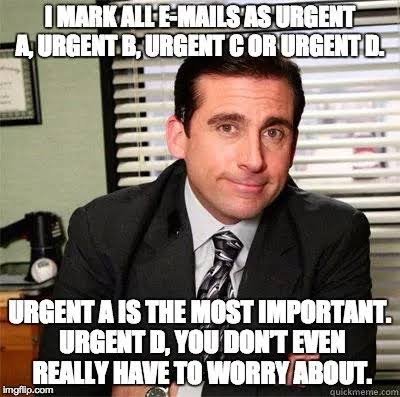
When everything is urgent, nothing is.
I combined my research with Amber Case’s design principles for notification design, and designed a holistic communication architecture and strategy playbook.
It grouped different content to meet the delicate attention-economy of HQ to Store Employees to ensure the communication methods aligned to employees’ mental models and real-life needs.
It gave the product team the evidence it needed to both decide and be the governing authority over what content belonged where in the app. They knew going in that not everything should be a push, but had no way to be enough of an authority to pushback to VPs that their communication request should not be a push and was better suited as X.
Crucially, it didn’t just cover urgency/priority, it covered the interpersonal needs within communication; how different modes of communication make employees feel valued (or not). Such as how getting an automated notification that your shift tomorrow has changed and is starting 1-hour earlier, vs. getting a call from a shift manager to discuss it.
This playbook had long-lasting impact. It was integral to shaping enterprise-wide communication strategy for years; being referenced years after its completion. (Which I know because I continued to get LinkedIn messages from teams at Best Buy about it.)
In my final report, I shared this clip from The Office with the warning, “Do we want to be Michael Scott?”